We interviewed 647 Indians about their gut health. Here’s what we found.
What apart from diet affects gut health?
That is the question we wanted to answer.
Specifically, we wanted to understand how fasting, sleep and antibiotic usage affects gas, bloating and acidity.
Dirty
or Clean?
Free Analysis
Here is a summary of our key findings.
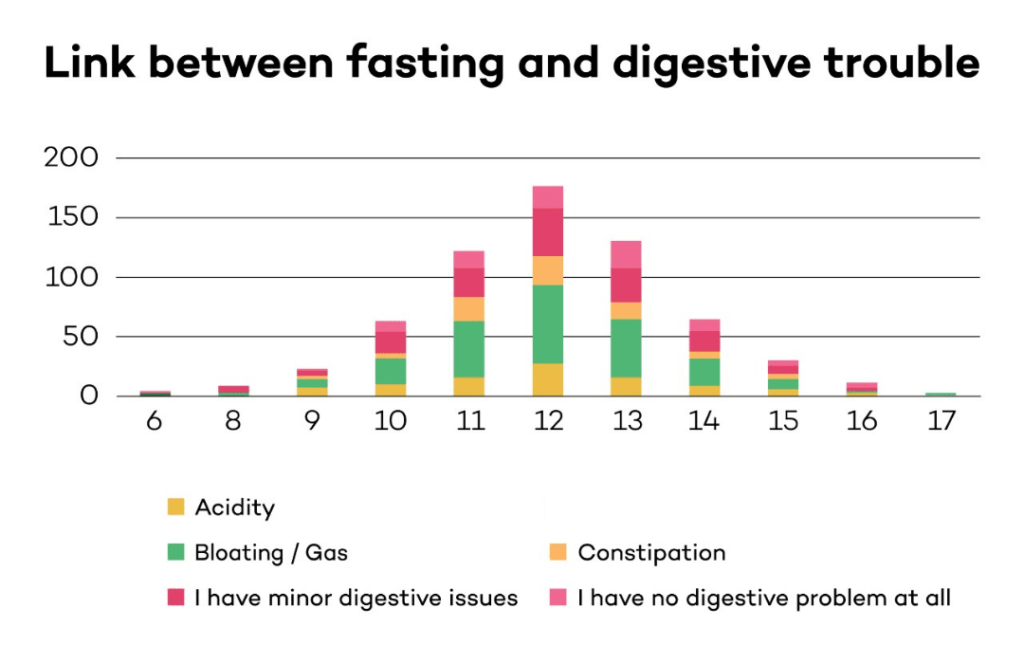
Fasting is on the rise. The average Indian fasts nearly 12 hours a day, and nearly 1 out of 5 Indians fast more than 14 hours a day.
Fasting does not seem to affect acidity, bloating, or constipation. Those who fast for up to 15 hours a day seem to have the same acidity, bloating, and constipation trouble as those fasting less than 12 hours.
Dinnertime seems to be linked to acidity and bloating. Those who eat dinner after 7 PM seem to have a much higher chance of acidity and bloating.
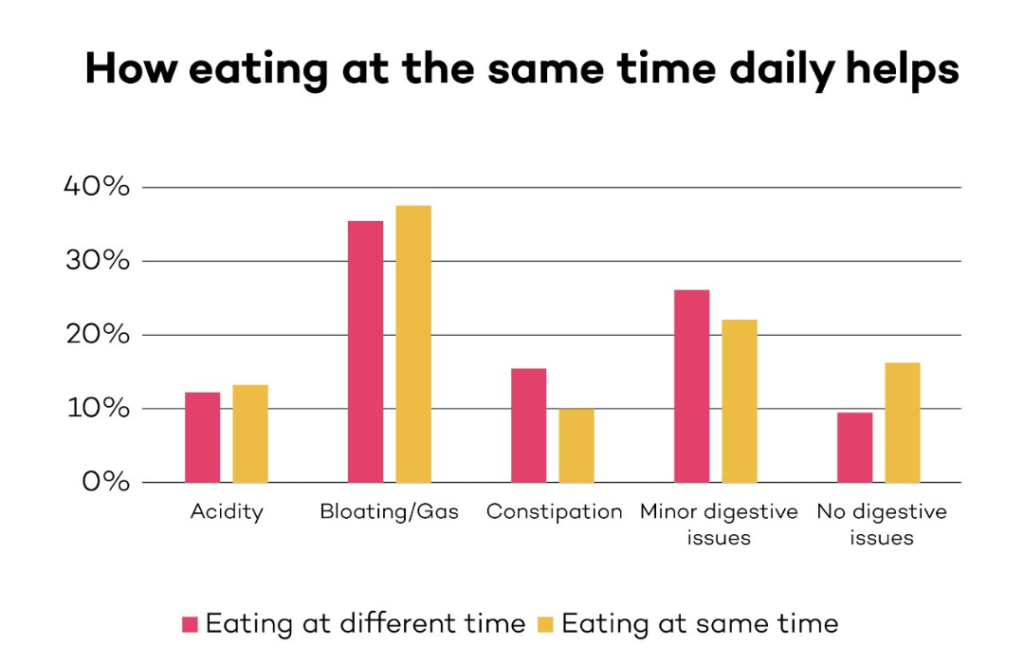
Eating at the same time daily may be beneficial for gut health, but only marginally.
Antibiotics do not seem to make a large difference to improve gut health when it comes to digestive trouble, although antibiotic usage seems to provide some type of bloating relief.
Sleep is clearly linked to digestive trouble, especially bloating. Nearly 40% of those sleeping for less than 6 hours a night suffer from bloating versus only 25% for those sleeping 8 hours or more.
Note: The majority of respondents are working professionals (between the ages of 30 and 50) from metros, and interviewed at the tail-end of the pandemic (Sept-Nov 2020).
How India Fasts
Nearly 30% of Indians eat breakfast after 10 AM…
…and a shocking 55% eat dinner after 9 PM.
How does this eating interval affect fasting?
The average Indian fasts for nearly 12 hours a day, and “intermittent fasting” seems to be on the rise.
Nearly 1 out of 5 Indians fast for 14 hours or more, daily.
Surprisingly enough, fasting does not seem to help with digestive troublelike gas, bloating or acidity.
People who fast for less than 12 hours suffer from acidity, gas and bloating to nearly the same extent as people who fast for 15 hours, daily.
This is a surprising and rather counter-intuitive finding.
Hundreds of studies have linked intermittent fasting to better insulin sensitivity, lower blood pressure, potential weight loss and improved gut health.
What about digestive trouble?
As this article from Harvard Health points out, there are two factors that directly affect how much fasting may help your body heal.
When you eat AND
What you eat
Eating in line with your body’s circadian rhythm (i.e. eating between sunrise and sunset), seems to offer some of the best results with fasting.
This segment of respondents (70+% who eat dinner after sunset) are eating outside their circadian rhythm.
Could this explain our findings with regards to fasting?
How dinner time affects acidity and bloating
There is a surprisingly strong correlation between the time you eat dinner and the chance you struggle with acidity.
The same pattern repeats for bloating, too.
How is dinner time linked to acidity / bloating, and why is there a drop off after 10PM?
We suspect it has something to do with sleep.
Anecdotal evidence suggests that most people who eat dinner between 9 and 10 PM usually go to sleep by 11 PM i.e. within an hour of eating dinner. Those who eat diner later than 10 PM, usually go to bed after 12 AM.
It is possible that the difference between dinner time and sleep timecould be the trigger for acidity and bloating, versus just dinnertime alone.
We’ll need further research to understand this link better.
Eating at the same time, daily
…. doesn’t make much of a difference.
This is especially interesting for acidity, where irregular meal times are often listed as a trigger point for acid refluxes.
Till date, studies have established that eating at the time daily is linked to better cholesterol and insulin levels. Few studies have linked mealtime discipline to digestive trouble.
Could it be possible that mealtime discipline is a peripheral or tertiary factory that may help only when combined with proper nutrition, sleep and hydration?
The Impact of Antibiotics
A surprising 40% of respondents have taken at least one dose of antibiotics in the past 6 months.
The effect that antibiotics have on bloating is well documented.
Bloating is closely linked with SIBO (small intestinal bacterial overgrowth), and antibiotics are often prescribed to eliminate excess bacterial colonies.
For the ones who still suffer from bloating despite a course of antibiotics, the answer often lies in the other major trigger of bloating: FODMAP food or foods containing highly fermentable sugars.
Of all respondents who have reported no digestive trouble at all, nearly twice as many had not taken any antibiotics in the past 6 months.
The link between gut health and sleep
The data shows three clear insights.
First, length of sleep affects bloating. Nearly 40% of all respondents sleeping for less than 6 hours a night report bloating, versus just 25% for those sleeping for more than 8 hours a night.
Second, nearly 3x more people report no digestive trouble at all when they sleep for more than 8 hours compared to those sleeping 6 hours or less.
Third, and rather surprisingly, sleep has virtually no effect on acidity or constipation.
A concluding note
Back to our original question: what apart from diet improve gut health?
Fasting hasn’t shown a strong correlation, while dinnertime, length of sleep and antibiotics seem to have an influence on digestive trouble.
None of the correlations are as significant as we expected, or as theory seems to suggest. Could we be missing some factors, most notably stress and diet?
Perhaps the single largest insight from our results is working around your diet is inadequate when it comes to gut health. Food, water, and stress play an equally important roles. Probiotic Indian foods can also improve gut health.
Said differently: fasting long hours and sleeping well without correcting diet may not lead to good gut health.
More, coming soon!
Isabgol side effects that may SHOCK you [2024 Update]
These 4 isabgol side effects may really surprise you.
Isabgol may reduce mineral absorption from your food
Isabgol may make you feel more constipated
With long term use, you may find it difficult to poop without isabgol
Isabgol can create serious gas
As with anything, you need to use isabgol carefully.
Dirty
or Clean?
Free Analysis
Isabgol side effects
#1 Isabgol may lower mineral absorption from your food
Studies show that supplementing your diet with isabgol may result in poor absorption of minerals, particularly calcium, phosphorous and iron.
There are two reasons for this:
Isabgol seems to bind to key minerals like calcium, making it very difficult for the digestive system to absorb the mineral.
Isabgol will draw water from anywhere to build the mass it needs to be pushed out of the digestive system. If you don’t drink enough water while consuming your isabgol, it will draw water from your body and cause a mineral imbalance.
Recommendation: Eat Isabgol 2 hours after a meal, and with a lot of water.
“I used to take isabgol at night. Now I just take this every morning”
❤️ by 300+ nutritionists
#2 Psyllium husk for constipation may make things worse
If you aren’t being able to move your bowels normally, then adding Isabgol may worsen the situation.
It’s like the signal isn’t turning green, but more cars are joining the traffic.
Adding isabgol to the mix may may slow-transit constipation even worse.
So psyllium husk is not the answer to hypothyroidism constipation.
Does Isabgol increase weight?
No.
Isabgol will make you feel full (and likely bloated).
This will pass once you use the toilet. It is virtually impossible for Isabgol to increase your weight.
The strong alternative to isabgol
❤️ by 300+ nutritionists
Buttermilk or milk for acidity?
Take milk for acidity or don’t take milk for acidity? Everyone has their own opinion.
It seems to work for some, and make acid reflux worse for others.
If you are looking to understand exactly how milk affects stomach acid (and acid reflux), this article is for you.
Before we begin, here is a small introduction to how your stomach works.
Basics about your stomach (and stomach acid)
Your stomach operates just like an air-conditioner.
Let’s say you set the A/C at 21 degrees.
If the room is warmer than 21 degrees, then the compressor turns on and the A/C throws out cold air.
The moment the temperature in the room drops below 21 degrees, the compressor turns off.
In the same way, your stomach is set to a particular level of acidity. This is measured in pH.
When you eat or drink something, the stomach starts to release acid to bring the pH back to normal.
When you eat or drink something very alkaline, the stomach releases even more acid to bring the pH back to normal.
What happens when I drink milk?
Milk is rich in calcium, protein and fat.
All three nutrients are broken down using stomach acid.
When you drink milk, your stomach will produce a lot of acid.
This isn’t necessarily bad; more acid does not mean you will have an acid reflux.
You will only have an acid reflux if your stomach acid spills into your food pipe.
“More acid? But milk seems to reduce my acidity.”
Milk can reduce your acid reflux, not your acidity.
Milk is very alkaline because it is rich in calcium.
When milk comes in contact with acid, it neutralizes the acidity so you don’t feel the burning sensation in your throat.
Milk will make your stomach produce more acid, but can reduce the intensity of acid reflux.
“Wait. In my experience, milk always seems to increase acidity!”
We have established that milk increases stomach acid.
If you have a dysfunctional LES (the muscle at the entry of your stomach that closes to keep acid in the stomach), then the excess acid can easily spill out and cause an acid reflux.
Diet, posture and belly fat are all linked to a dysfunctional LES. You can learn more, here.
Is this the same for all dairy products?
Not quite.
Milk becomes whey + paneer when you split it. Paneer contains most of the fat, so paneer increases stomach acid, but whey doesn’t have much of an effect.
Milk becomes dahi + buttermilk when you ferment it. Fermentation converts the sugar in milk to acid, so dahi and buttermilk are both more acidic than milk.
To give you an idea, milk has a pH close to 6.5.
Buttermilk has a pH close to 4.5.
Dahi and buttermilk do not increase acidity as much as milk does.
Is this why we drink buttermilk after a meal?
Yes.
Your stomach normally operates at pH 1-3.
After we eat, it goes to pH 3-5.
Drinking milk (pH 6-7) can upset the stomach by neutralizing acid and interfering with digestion.
In fact, drinking water (ph 6-7) and alkaline water (pH 8-9) can also upset the stomach by neutralizing acid and interfering with digestion.
Because buttermilk has a lower pH so it works well with the mix in your stomach, and helps digestion.
The same goes for Solkadhi – an end of meal drink made with kokum and coconut. It is a low pH drink which is in line with stomach acidity, and assists digestion.
But milk is alkaline. Isn’t alkaline always good?
No.
Let’s say your stomach was alkaline. Here’s what would happen:
You would not be able to digest protein properly. This would waste nearly 50-60% of the protein you eat daily.
You would not be able to absorb Vitamin B12 or Calcium. This would lead to serious deficiency in energy, cognitive health and bone health.
You would not be able to stop bad bacteria and yeast from entering your system. This would lead to candida infections or bacterial overgrowth – linked to both bloating and constipation.
Your stomach makes acid for a reason.
Alkaline food and water is helpful for temporary relief from acid reflux.
It is not recommended for at least 3 hours after a meal.
So, should I have milk for acidity?
If you are looking for temporary relief from acid reflux, cold milk may help.
If you have acid reflux around mealtimes, try buttermilk instead.
If you want a permanent solution for acidity, milk will do absolutely nothing.
Want to get rid of constipation fast at home? You’ve come to the right place.
Senna leaves, isabgol and other laxatives take 8-10 hours to work.
This post outlines a simple 3-step how-to technique ….
…that may provide instant constipation relief in less than 15 minutes.
Step 1: Flex your gut muscles
First, find a flat surface. A yoga mat or a bed will work.
Lie down, face up, and hug your knees like this.
Step 1 of how to get rid of constipation fast at home
Hold it for a few seconds, and then let go.
Repeat 2-3 times to free your legs.
Now, repeat one more time but this time, hug your knees as tight as you can.
Breathe out, and raise your head to your knees.
Try to hold for 5 counts.
If you can do 5, push for 10.
If you can do 10, push for 15.
Relax, breathe in again.
Repeat one more time.
Here is a guided video for you.
https://youtu.be/1FWpqTY8HoM
If you want to try something a little more advanced, try this variation instead.
https://youtu.be/wqM9-bjqzms
Step 2: Build pressure
After step 1, get a large glass of water.
Heat it until it is warm. That’s about 50 to 60 degrees.
If you are doing it in the oven, keep it for 20 seconds.
Sip on it while sitting down. Once you have finished the glass, walk around for 300 – 500 steps.
This will give some time for the water to settle in your stomach.
You may start feeling a bit of pressure.
The juice to eat without bloating
❤️ by 300+ nutritionists
If you don’t, gently massage your gut in a counter clockwise session.
Right to left.
Note: your gut is roughly an inch around your belly button. That’s what you want to target.
There is a chance you’ll feel a knot in the bottom left or bottom right hand side.
Gently press down on it. Don’t press it too hard – your aim is to just move the knot along your digestive system.
Try to push it clockwise from right to left.
If you feel some pressure, head straight for the bathroom.
If you don’t, you still need to head to the bathroom for step 3.
Step 3: Open the gates
If you are using a typical, western toilet, try to find a small stool that helps you raise your knees above your waist.
The position looks something like this.
Step 3 of how to get rid of constipation fast at home
If you don’t have a step stool, you can use an upside down bucket.
Studies have conclusively proved that the human body was designed to poop in a squatting position.
Try it once, and you’ll understand how large of a difference it makes.
That’s it.
That’s the three step technique that has worked for over 80% of people struggling with constipation – chronic or mild.
Just have faith. There is no reason it won’t work for you too.
Get rid of constipation fast at home, long-term
If you have a little bit of time, you can try a laxative the night before.
The two most commonly used, natural laxatives include senna leaves and isabgol.
Senna leaves work by contracting the colon, so your waste moves.
Isabgol adds more mass to push your waste. Isabgol side effects can be painful so its’s better to find an alternate.
Both are certified safe in small quantities, but will only provide temporary relief.
If you are looking to get rid of constipation at home, permanently, you may want to start by reading this guide.
Right way to eat curd or dahi
Curd is a pretty effective, natural probiotic and prebiotic.
Depending on which part of India you are from, curd can contain 10-30 million colonies / 100ml of up to 250 different types of bacteria.
Yakult, in comparison, has up to 6.5 billion colonies / bottles of just 1 strain of bacteria.
Research has shown some of these bacteria survive stomach acid and enzymes to make it to your intestine alive. You can learn more about which strains survive (L. Casei) here.
Strains which survive make it to the intestine, push out bad bacteria and support gut health by helping digest food your gut would otherwise be unable to.
To get all the benefits, you must understand how to eat curd…
… and when to eat curd.
This post outlines the right way (and time) to eat curd.
Should I eat sour or chunky curd?
No.
Curd becomes chunky and sour if has been fermented for too long.
Bacteria are eating the sugar (lactose) in curd and releasing lactic acid (making it sour).
Lots of people report digestive trouble when they consume sour curd.
Ayurveda indicates that sour curd is very difficult to digest and recommends you either eat very little, or just leave it alone.
So eat curd fresh within a few days of making it.
Side note: curd will begin souring very fast the moment you put a spoon through it.
“Curd = Probiotics. This juice = prebiotics”
❤️ by 300+ nutritionists
Which curd is better for me, sweet or salty?
It is common to have curd with jaggery or misri (sweet version) or curd with salt or spices (salty version).
Sweet curd is recommended for those struggling with excess body heat, acidity and hairfall.
It is extremely cooling for the body.
Salty curd is recommended for those struggling with gas and indigestion, as it promotes complete digestion.
What can you add to your curd? Read on…
What can I mix with my curd?
If you are going sweet, opt for small amount of misri or jaggery and avoid table sugar.
The refined variety isn’t good for your health, and it seems to affect growth of bacteria in the curd.
Less bacteria = less effectiveness.
With refined sugar, you are essentially killing the nutritional property of the curd.
You know what else does the same thing… …table salt.
Refined table salt sometimes contains Iodine which a lot of bacteria cannot handle.
Opt for himalayan pink salt or a pinch of rock salt.
When it comes to spices, you must add cumin (Jeera).
Jeera is anti-fungal, and it seems to stop any ‘bad’ microbes from growing alongside the good microbes.
Side note: Add Jeera in with the curd while it is being made. Not just before eating.
Some ingredients you should never mix include turmeric, clove and garlic. Why? They are very strong anti-microbials. This means they slowly kill the good (and bad) bacteria in curd.
Less bacteria = less effectiveness.
Ideally, you should avoid these spices 30 minutes before or after eating curd.
This is why curd isn’t best during meals.
When should I eat my curd?
Have cool curd on an empty stomach, and wait 30 minutes before eating anything else.
Curd contains ‘good’ bacteria which need to survive stomach acid and make it to your gut.
For most people, stomach acid is low in the morning time.
This increases the chance that good bacteria make it to the gut.
Ayurveda recommends you can have it daily during winter, and every alternate day during summer.
Curd isn’t recommended during the rainy reason.
The biggest ‘don’t’ with curd
Don’t eat curd at night.
Curd is a demulcent.
It means the body releases mucus (nose, intestines etc) when you eat curd.
When you consume curd at night, this effect is much stronger. So when you wake up in morning, you may feel congested and/or constipated.
Avoid curd at night.
More questions?
Write us an email on hello@hatabevtech.com, and we’ll get back to you!
Curd = Probiotics. This juice = prebiotics
❤️ by 300+ nutritionists
Colon Hydrotherapy | Read before you spend Rs. 35,000
Colon hydrotherapy is a way to clean your colon using water.
A trained therapist will pass warm, filtered water through your rectum (bottom) until it fills the entire large intestine (about 6 feet long).
Then, he/she will massage your abdomen so that the added pressure works with the water to remove old waste and undigested food from your system.
This article will help answer most of your questions around the procedure, and offer an alternative with is 30x cheaper at the end.
Pre & Post Procedure
Can’t the gut clean itself?
Yes, partly.
The body’s natural gut cleaning process is mechanical. This means the gut walls close in and out to push food and waste along.
Sometimes, if the food doesn’t have enough mass (i.e. is poor in fiber), the gut wall cannot push that food along because there is ‘very little’ to push.
These food particles may remain in your large intestine, and harden over time.
This is called faecal impactation and is linked to all sorts of digestive nuisance from IBS to bloating to even ‘feeling heavy.’
If you score 70% or less, you probably need a gut cleanse. Colon hydrotherapy or other solutions may help.
70% of Indians have a dirty stomach. Are you one of them?
Colon hydrotherapy only cleans the large intestine. Why?
Most people who have not eaten solid food in 12 hours will have a sparkling clean small intestine.
This is because the small intestine automatically flexes and pushes old waste to the large intestine.
In the large intestine, food can stay for 16 to 48 hours, depending on what you have eaten and your body type.
That’s where the trouble may occur.
Does all the waste come out in one session?
Not in one session, but it makes a significant difference.
See the video below to see a live colon hydrotherapy session (outside Mumbai).
https://www.youtube.com/watch?v=Yx5D75XjH64
Will colon hydrotherapy wash away my gut bacteria too?
Most practitioners will hesitate to answer this question.
Once your colon is washed, you have likely flushed out a significant portion of your gut bacteria too. There is no control; both good and bad bacteria will leave your body.
The result: you may actually feel a little weak after your first session.
Restoring your natural gut profile may take up to two weeks after your last colon hydrotherapy session.
These two weeks are absolutely crucial. You can read this research piece on 23 subjects before and after colon hydrotherapy.
What’s the difference between enema and colon hydrotherapy?
An enema just washes the lower bit of the large intestine (i.e. 1-2 feet).
Colon hydrotherapy can wash your whole large intestine (5-6 feet).
What do I do after the session?
You have to be extremely careful about what you eat for the next two weeks.
In a sense, your body is weakened. Old waste has been pushed out alongside friendly gut bacteria as well.
Whatever you eat has a massive impact now.
If you eat dirty, your health condition may actually worsen. You need to eat clean, slightly cooked food and natural probiotics like dahi.
Do not eat raw food. Raw food may carry a lot of harmful microbes which may inhabit your gut with more ease until your gut profile is restored.
See the video below to understand how enema can go wrong (or lead to the release of a whole of toxins that are struggling to leave you system).
In Basti, you keep the oil in your gut for at least 30 minutes
The objective of a Basti is not just to clean, but to deliver the right herbs straight to the colon.
When we eat food, less than 50% gets absorbed by the body. In a Basti, >90% may get absorbed by the body.
Ayurvedic practitioners figured this out, and use Basti as a nutrient delivery mechanism, not just a gut cleanse.
Colon hydrotherapy cost in India
What does colon hydrotherapy cost?
Starts from Rs. 5000 a session in Tier 1 cities like Mumbai or Delhi.
The procedure usually lasts around 40 minutes a session. Usually, 2 sessions a week over three weeks is what is recommended.
That’s a bill of Rs. 30,000 + GST (at minimum) that most Indian Insurers will not cover.
Can’t I just do it at home?
We don’t recommend it.
You have to be very careful about (1) the type of water you use and (2) how you massage your abdomen when the water is in your gut.
If you use water that has not been properly filtered or has bacteria / harmful chemicals, it may create a lot of trouble.
Do not opt for enema just to offset colon hydrotherapy cost.
Isn’t it cheaper to just have a laxative vs. colon hydrotherapy?
A laxative acts faster.
Osmotic laxatives (which brings water into the system), stimulant laxatives (which makes gut muscles work harder), emollient laxatives (makes your poop slippery) all offer relief from constipation by encouraging waste to leave the system.
Too many laxatives, though, create dependence and often lead to loss of gut muscle tone.
Said differently – a laxative is a quick-fix, not a long-term solution.