Probiotic drinks like Kombucha were honestly too expensive to make into a daily ritual.
I wasn’t satisfied.
Then, my friend suggested ash gourd juice and it popped up on my radar again. She said that it would act like a cure for both my issues. After going through a fair share of trial and errors, I thought that this was worth giving a shot.
The worse that could happen was that it would not show results.
Dirty
or Clean?
Free Analysis
What is Ash gourd juice?
When my friend introduced me to ash gourd I was most certainly confused because I had never heard of it or seen it.
After searching online and asking a local vegetable vendor I found out that it is a white, thick fleshed, and sweet vegetable that has a waxy coating.
It is widely known as white pumpkin or winter melon, and is very commonly used in Indian religious rituals too.
“So happy I switched from Ashgourd to this”
❤️ by 300+ nutritionists
My experience with Ash gourd juice
Upon trying it for the first time, I realized that is tastes a lot like cucumber, but sweeter. This resemblance is due to the high-water content in the vegetable which makes it great for weight loss as well.
In the juice form it felt quite refreshing to drink and was overall a pleasant experience.
I decided to make it a ritual to drink the juice early in the morning on an empty stomach every day for 30 days.
Unlike other drinks that I have tried in a similar fashion prior to this, ash gourd juice was definitely easier on the taste buds and not too aggressive of a flavor.
After drinking it for the first 10 days, I got slightly bored of the taste.
So to cut off the sweetness a tad bit, I added some squeezes of lemon to the juice as well.
Did it work?
After the first week of drinking it, I could tell that my gastric issues had definitely become less pertinent.
I felt a little heavy every time I drank the juice, but the next day the amount of stool I was passing really increased. It felt like everything was getting cleaned inside.
After 12 to 15 days of drinking the juice, I started to see some positive changes in my skin, too. Some acne that I had from prior to drinking the juice were starting to clear up and became less visible.
This makes sense – experts online keep saying that skin health is linked to gut health.
In addition to this I also saw a change in how hydrated I was. Given the water filled nature of the vegetable itself, I felt quite nourished and hydrated throughout the day.
The journey of drinking it for 30 days was definitely coming to fruition.
Please note: I hadn’t made any changed to my diet.
After day 25, the skin didn’t clear anymore. It felt very regular, like drinking water.
I started researching online and realized that any juice consumed for too long will stop giving results.
It’s almost as if the body gets too used to it.
Ash gourd juice side effects
I also learned a lot about the ash gourd juice side effects – something most people do not even talk about.
On the surface ash gourd seems to be a pretty good way to solve gastric or skin related issues but there are some limitations to it.
#1 It is said that having excess amounts of ash gourd juice or for a prolonged period can cause phlegm. This can be attributed to its waxy nature and can be detrimental in general as well as for people who have asthma or bronchitis.
#2 The vegetable also has a high amount of minerals in it. Therefore, drinking it for a long period of time can lead to toxic levels of metallic substances being accumulated in the body.
#3 The juice isn’t a shortcut – you have to change your lifestyle too. Otherwise, you’ll get the same stomach and skin problems you had when you get off it.
However, if you’re looking for natural ways to improve your gut-health and skin, you can always try Kalmegh Bitters
Click to know the easy way to improve stomach health.
The final verdict
While my experience has been good, it is understandable that everybody is different.
It is also important to note that this is a very short-term cure for your problems and to get a solution that lasts, it is important that you sought to something that is specially curated for those purposes.
Today, I alternate between two juices every month: ash gourd juice and Kalmegh Bitters.
Kalmegh Bitters is another natural juice that really makes me feel energetic, light, fresh, helps in face clean up and reduces bloating.
Honestly, this ritual works well for me. Find your own ritual, and become healthy today!
In 2016, after many years of achy nights and bottles of joint pain oil, my mother was diagnosed with rheumatoid arthritis (RA).
Her physician told her that she has to take medication for RA for the rest of her life.
Soon after, my father started complaining about his excruciating knee joint pain and stiffness; I think his diabetes was progressing fast.
Joint pain oil didn’t help him, either.
My name is Alvina Nawed, and I am a candidate for MSc in Rehabiliation sciences
Given my background, I taught my parents a few exercises to ease their pain.
It helped, but after a point, their suffering became intolerable.
As a result, they couldn’t continue those exercises either.
Even on multiple medications, my parents got no relief.
Their fatigue got worse and joints turned stiffer with very little to no real everyday routine movements.
My education has made one thing clear: any type of arthritis drugs hardly address the cause of the illness.
These pills work only to ease symptoms like pain and stiffness temporarily.
The juice to eat without bloating
❤️ by 300+ nutritionists
In fact, they are known to cause side effects if not taken in moderation.
Joint pain oil does the exact, same thing.
A better alternative to joint pain oil
Disappointed with no tangible improvement, I turned to extensive research on functional medicine and anti-inflammatory substances that work on the base level.
I wanted to dig deeper into what might respond effectively to these autoimmune problems.
This immune response can get triggered by absolutely anything, such as extreme stress, poor diet, excessive use of antibiotics, insignificant physical activity, poor gut health
After going through a couple of articles, I discovered Kalmegh which is a green plant, exhibits anti-inflammatory and antioxidant properties.
It also helps to cleanse the liver and function to improve gut health.
Fortunately, I came across Kalmegh Bitters on Amazon last year while looking up drinks/supplements that contain Kalmegh as an ingredient.
Image of Kalmegh Bitters
I immediately examined their website and placed an order of 24 bottles as a one time course for my mother.
Ever since the improvements she has undergone are worth a read.
Is your stomach clean or dirty?
80% of Indians score less than 70/100
End of week 1 | More energy
My mother started feeling energetic within the first week itself.
There was no real difference in her joint pain, but the fact that the product was natural and bitter gave her the confidence to continue.
End of month 1 | No more joint pain oil
Amazingly, both my parents stopped using their joint pain oil.
Their energy levels soared high.
My mother was able to have a sound sleep unlike before…
… and my father resumed his business.
He even initiated his daily morning walks which is essential given he is a diabetic patient.
I became so confident, that I ordered a few more sets of 24.
End of month 6 | Incredible results
My mother started offering namaz while standing which was an exhausting affair before.
She was able to stand for longer durations and began working in the kitchen once again.
This made her not only optimistic but delighted.
My mother lost a few kgs with no dietary modification. Her appetite improved as well. She craved less sugar and was able to keep a more balanced diet.
My father resumed his exercise program and became more active.
Both my parents felt light with robust energy due to improved digestion and regular bowel movements.
Both of them had reduced stress levels with 8-9 hours of solid sleep.
They no longer have to keep popping pills for extreme stiffness and pain that was damaging their kidneys in the long run.
Now, they are active enough to be able to take control of their lives without much domestic help.
Unlike before, they don’t bring up excuses to not attend family gatherings and functions.
Keep in mind, the only change they brought into their routine was Kalmegh Bitters.
Why I recommend Kalmegh Bitters instead of joint pain oil?
Because I believe in functional medicine.
Bitter is composed of natural, no preservatives, no chemicals, no sugar, ingredients.
It claims to cleanse your liver from free radicals and in turn works on the healing process.
Moreover, it reduces inflammation in the gut which I suppose was the reason for the overworked immune system in my parent’s case.
I believe that bacteria imbalance in the gut could be one of the key factors to trigger RA.
Bitters helped to relax their immune system by allowing the growth of good bacteria in the gut wall, which must have promoted healing.
https://youtu.be/py9S1a9ddyI
Every person is unique and sometimes they need more than dietary modifications, exercises, medicines to have a considerable impact on any kind of illness, not just RA.
One thing is for sure.
After spending years on traditional medicines to relieve joint pain, my parents never felt this good and free of chronic symptoms.
They are still in contact with their physicians, but those monthly visits are not required anymore.
As a student of physiotherapy and rehabilitation sciences, if you or your loved ones are struggling with joint pain, I recommend Kalmegh Bitters.
I have used a constipation syrup on and off since the past 5 years.
But when I was diagnosed with hypothyroidism in 2019 after a major stressful event, I started using it very regularly.
After diagnosis, I was put on thyroxine and was told to manage anxiety.
There is a lot that hypothyroidism brings with it: constipation, extreme exhaustion, dry skin and unexplained weight gain.
My #1 problem has been constipation. I used to have constipation even before my thyroid, and now it had gotten really bad.
Constipation is a taboo that almost every hypothyroid patient suffers from in their lifetime. Still, nobody bats an eye about it.
After years of trial and error, I’ve managed to get my constipation under control.
I’m writing today to share my story. For real change, we must discuss all issues – even the most embarrassing ones.
So, here it goes.
Reducing dependency on constipation syrup
Likewise, everybody is unique and responds to different substances differently.
For instance, constipation syrup worked on me, but whenever I stopped using it, my digestion felt very irregular.
I also tried isabghol/psyllium husk for a long time every day without fail, but I couldn’t relieve constipation.
The juice to eat without bloating
❤️ by 300+ nutritionists
Constipation syrup or Isabgol may have worked brilliantly for a lot of people out there but did absolutely nothing for me, instead long term use lead to isabgol side effects.
So I kept trying new things to see what works: warm lemon water, apple cider vinegar, etc.
It was somewhere in December 2019, a nutritionist friend of mine introduced me to Kalmegh Bitters.
She told me to replace my morning drink with Kalmegh Bitters and observe how my metabolism changes.
Honestly, being a science geek and an evidence-based researcher, I don’t just buy what I am told.
So, as soon as she told me about it, I started exploring their website to know what I am going to introduce into my body.
To my surprise, this drink claimed to focus on the gut – which immediately caught my eye because of my constipation problem. Apple cider vinegar has never helped in that regard, and so I was looking to change it in the first place. In fact, apple cider vinegar side-effectscreated more problems.
Of course, there were zero preservatives, zero additives, and no chemicals – it was all-natural.
What captivated me the most was that it has no dairy products or extracts either. Being lactose intolerant, I have to struggle a lot with what I put into my body. This was indeed enough to push me to try it.
And guess what, it certainly turned out to be the turning point in my journey of chronic constipation.
Is your stomach clean or dirty?
80% of Indians score less than 70/100
End of week 1 | fewer hunger cravings
I started soaking up this morning drink in mid-December with high hopes.
I took my thyroid medication first thing in the morning, then waited for half an hour before taking Kalmegh Bitters. I then waited for another half hour before eating breakfast or drinking tea/coffee.
Apart from other issues related to the thyroid, lethargy had completely taken over my life.
It came packed in these really cute bottles, but my god it was quite bitter!
Honestly, the taste gave me more confidence.
I never believe in “sugary probiotic drinks or energy drinks that promise a combination of taste + health.” If it’s sweet – it’s got sugar.
Sugar messes up the body like nothing else. I am informing you of this with my personal experience. If you don’t believe me, try those drinks for a week and jot down how your body feels.
I had purchased one course – 24 bottles – so I kept drinking Kalmegh Bitters every morning.
By the end of the first week, I felt a difference in my energy levels. I used to nap every afternoon, but after 3 days of Kalmegh, I didn’t feel like I needed to anymore.
I was also craving a little less sugar.
7 days had convinced me to try it further. I was curious: What would happen in 24 days?
End of month 1 | No more constipation syrup
My digestion considerably improved after a daily dose of bitter.
Bowel movements became regular, and I started getting that pet saaf wali feeling after so, so long.
I even felt less bloated. Remember: this is without any constipation syrup, laxatives or crazy exercise. Kalmegh Bitters was the only dietary change.
There was one other significant improvement: my mood.
The brain fog that comes along with hypothyroidism is no joke. It makes you more irritable.
While I wasn’t expecting it to restore my extreme mood swings. I realized my temperament improved and I was able to focus more than usual.
End of month 2 | Far more control
The energy and lightness in my body kept improving.
There were a few days I even woke up naturally before my alarm rang.
I think the only word that can describe it was, vitality.
I had enough in the fuel tank to consider proper exercise, and so I decided to work out to build a stronger core and immune system too.
Bitters helped my diet as well. Eating habits became more disciplined as I wasn’t dealing with constant hunger pangs like before.
I used to take 3 biscuits with tea every afternoon, now I was happy with just 1.
It felt like my morning drink was giving me control of my day.
It was setting the right tone, and it has become a daily ritual.
Wake up, drink Kalmegh Bitters and start my day.
It feels like I govern my day, not my hypothyroidism. I can predict how I am going to feel and react to situations that are easy to handle now, unlike before.
This may seem surprising – but I’m sure most people with hypothyroid will relate.
I recommend Kalmegh Bitters
Bitter is not just some random energy drink that only works on your energy levels, it does more than that. It works as a prebiotic which works at your gut-level to relieve bloating and rebuild your gut wall. It also helps cleanse your liver.
How is digestion linked to better energy, hunger cravings, and mood control?
Good digestion is everything.
The science behind this is quite simple. Your gut has a balance of good and bad bacteria. Any imbalance in the ratio of these bacteria, owing to bad eating habits, sleeping habits, stress, even adapted metabolic diseases, hormonal imbalances, can lead to low immunity and wreck your entire digestive system.
This causes enough damage to impact other bodily functions too.
With bitterness, it feels like my body has started to heal as it has worked amazingly on my gut and liver health since the very first day.
It has not just given me a huge relief from constipation but boosted the overall health.
If you are reading this article and suffer from chronic constipation, I seriously urge you to please get your thyroid tested.
Specifically, we wanted to understand how fasting, sleep and antibiotic usage affects gas, bloating and acidity.
Dirty
or Clean?
Free Analysis
Here is a summary of our key findings.
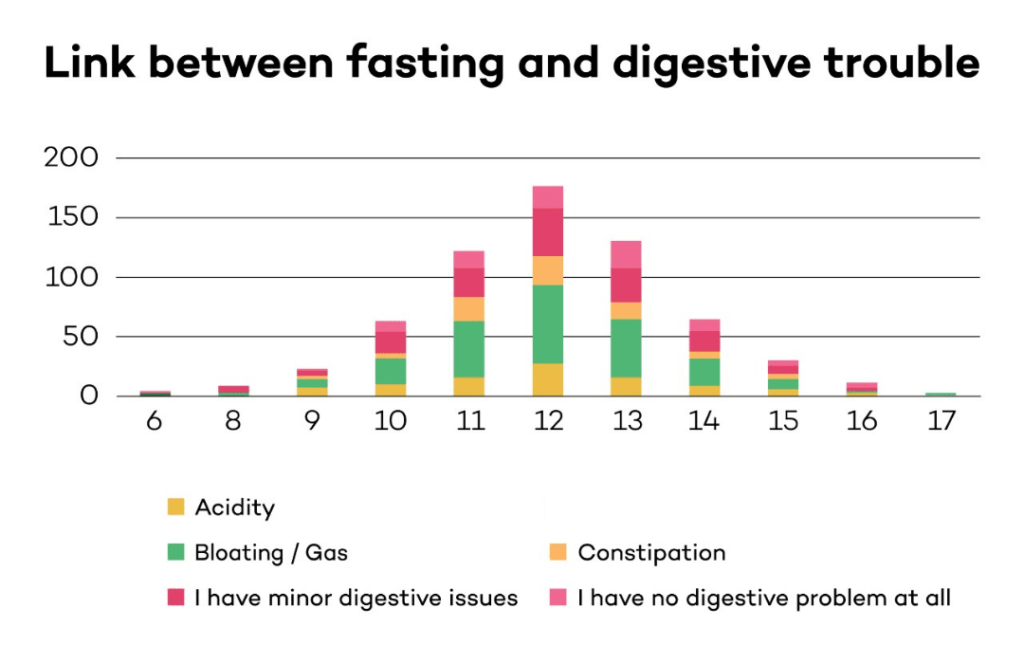
Fasting is on the rise. The average Indian fasts nearly 12 hours a day, and nearly 1 out of 5 Indians fast more than 14 hours a day.
Fasting does not seem to affect acidity, bloating, or constipation. Those who fast for up to 15 hours a day seem to have the same acidity, bloating, and constipation trouble as those fasting less than 12 hours.
Dinnertime seems to be linked to acidity and bloating. Those who eat dinner after 7 PM seem to have a much higher chance of acidity and bloating.
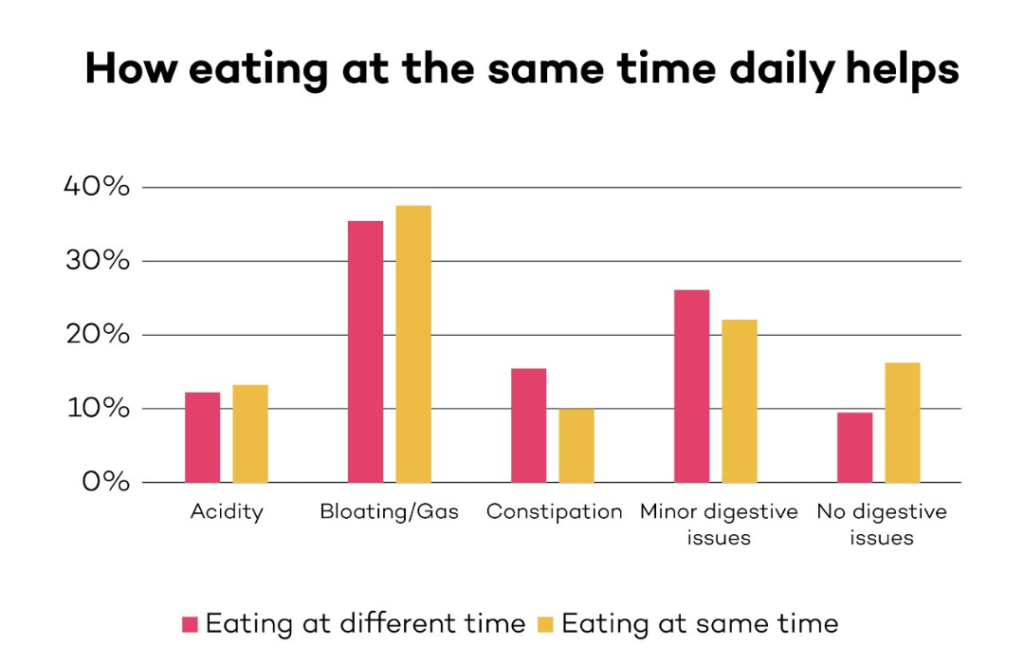
Eating at the same time daily may be beneficial for gut health, but only marginally.
Antibiotics do not seem to make a large difference to improve gut health when it comes to digestive trouble, although antibiotic usage seems to provide some type of bloating relief.
Sleep is clearly linked to digestive trouble, especially bloating. Nearly 40% of those sleeping for less than 6 hours a night suffer from bloating versus only 25% for those sleeping 8 hours or more.
Note: The majority of respondents are working professionals (between the ages of 30 and 50) from metros, and interviewed at the tail-end of the pandemic (Sept-Nov 2020).
How India Fasts
Nearly 30% of Indians eat breakfast after 10 AM…
…and a shocking 55% eat dinner after 9 PM.
How does this eating interval affect fasting?
The average Indian fasts for nearly 12 hours a day, and “intermittent fasting” seems to be on the rise.
Nearly 1 out of 5 Indians fast for 14 hours or more, daily.
Surprisingly enough, fasting does not seem to help with digestive troublelike gas, bloating or acidity.
People who fast for less than 12 hours suffer from acidity, gas and bloating to nearly the same extent as people who fast for 15 hours, daily.
This is a surprising and rather counter-intuitive finding.
Hundreds of studies have linked intermittent fasting to better insulin sensitivity, lower blood pressure, potential weight loss and improved gut health.
What about digestive trouble?
As this article from Harvard Health points out, there are two factors that directly affect how much fasting may help your body heal.
When you eat AND
What you eat
Eating in line with your body’s circadian rhythm (i.e. eating between sunrise and sunset), seems to offer some of the best results with fasting.
This segment of respondents (70+% who eat dinner after sunset) are eating outside their circadian rhythm.
Could this explain our findings with regards to fasting?
How dinner time affects acidity and bloating
There is a surprisingly strong correlation between the time you eat dinner and the chance you struggle with acidity.
The same pattern repeats for bloating, too.
How is dinner time linked to acidity / bloating, and why is there a drop off after 10PM?
We suspect it has something to do with sleep.
Anecdotal evidence suggests that most people who eat dinner between 9 and 10 PM usually go to sleep by 11 PM i.e. within an hour of eating dinner. Those who eat diner later than 10 PM, usually go to bed after 12 AM.
It is possible that the difference between dinner time and sleep timecould be the trigger for acidity and bloating, versus just dinnertime alone.
We’ll need further research to understand this link better.
Eating at the same time, daily
…. doesn’t make much of a difference.
This is especially interesting for acidity, where irregular meal times are often listed as a trigger point for acid refluxes.
Till date, studies have established that eating at the time daily is linked to better cholesterol and insulin levels. Few studies have linked mealtime discipline to digestive trouble.
Could it be possible that mealtime discipline is a peripheral or tertiary factory that may help only when combined with proper nutrition, sleep and hydration?
The Impact of Antibiotics
A surprising 40% of respondents have taken at least one dose of antibiotics in the past 6 months.
The effect that antibiotics have on bloating is well documented.
Bloating is closely linked with SIBO (small intestinal bacterial overgrowth), and antibiotics are often prescribed to eliminate excess bacterial colonies.
For the ones who still suffer from bloating despite a course of antibiotics, the answer often lies in the other major trigger of bloating: FODMAP food or foods containing highly fermentable sugars.
Of all respondents who have reported no digestive trouble at all, nearly twice as many had not taken any antibiotics in the past 6 months.
The link between gut health and sleep
The data shows three clear insights.
First, length of sleep affects bloating. Nearly 40% of all respondents sleeping for less than 6 hours a night report bloating, versus just 25% for those sleeping for more than 8 hours a night.
Second, nearly 3x more people report no digestive trouble at all when they sleep for more than 8 hours compared to those sleeping 6 hours or less.
Third, and rather surprisingly, sleep has virtually no effect on acidity or constipation.
A concluding note
Back to our original question: what apart from diet improve gut health?
Fasting hasn’t shown a strong correlation, while dinnertime, length of sleep and antibiotics seem to have an influence on digestive trouble.
None of the correlations are as significant as we expected, or as theory seems to suggest. Could we be missing some factors, most notably stress and diet?
Perhaps the single largest insight from our results is working around your diet is inadequate when it comes to gut health. Food, water, and stress play an equally important roles. Probiotic Indian foods can also improve gut health.
Said differently: fasting long hours and sleeping well without correcting diet may not lead to good gut health.
These 4 isabgol side effects may really surprise you.
Isabgol may reduce mineral absorption from your food
Isabgol may make you feel more constipated
With long term use, you may find it difficult to poop without isabgol
Isabgol can create serious gas
As with anything, you need to use isabgol carefully.
Dirty
or Clean?
Free Analysis
Isabgol side effects
#1 Isabgol may lower mineral absorption from your food
Studies show that supplementing your diet with isabgol may result in poor absorption of minerals, particularly calcium, phosphorous and iron.
There are two reasons for this:
Isabgol seems to bind to key minerals like calcium, making it very difficult for the digestive system to absorb the mineral.
Isabgol will draw water from anywhere to build the mass it needs to be pushed out of the digestive system. If you don’t drink enough water while consuming your isabgol, it will draw water from your body and cause a mineral imbalance.
Recommendation: Eat Isabgol 2 hours after a meal, and with a lot of water.
“I used to take isabgol at night. Now I just take this every morning”
❤️ by 300+ nutritionists
#2 Psyllium husk for constipation may make things worse
If you aren’t being able to move your bowels normally, then adding Isabgol may worsen the situation.
It’s like the signal isn’t turning green, but more cars are joining the traffic.
Take milk for acidity or don’t take milk for acidity? Everyone has their own opinion.
It seems to work for some, and make acid reflux worse for others.
If you are looking to understand exactly how milk affects stomach acid (and acid reflux), this article is for you.
Before we begin, here is a small introduction to how your stomach works.
Basics about your stomach (and stomach acid)
Your stomach operates just like an air-conditioner.
Let’s say you set the A/C at 21 degrees.
If the room is warmer than 21 degrees, then the compressor turns on and the A/C throws out cold air.
The moment the temperature in the room drops below 21 degrees, the compressor turns off.
In the same way, your stomach is set to a particular level of acidity. This is measured in pH.
When you eat or drink something, the stomach starts to release acid to bring the pH back to normal.
When you eat or drink something very alkaline, the stomach releases even more acid to bring the pH back to normal.
What happens when I drink milk?
Milk is rich in calcium, protein and fat.
All three nutrients are broken down using stomach acid.
When you drink milk, your stomach will produce a lot of acid.
This isn’t necessarily bad; more acid does not mean you will have an acid reflux.
You will only have an acid reflux if your stomach acid spills into your food pipe.
“More acid? But milk seems to reduce my acidity.”
Milk can reduce your acid reflux, not your acidity.
Milk is very alkaline because it is rich in calcium.
When milk comes in contact with acid, it neutralizes the acidity so you don’t feel the burning sensation in your throat.
Milk will make your stomach produce more acid, but can reduce the intensity of acid reflux.
“Wait. In my experience, milk always seems to increase acidity!”
We have established that milk increases stomach acid.
If you have a dysfunctional LES (the muscle at the entry of your stomach that closes to keep acid in the stomach), then the excess acid can easily spill out and cause an acid reflux.
Diet, posture and belly fat are all linked to a dysfunctional LES. You can learn more, here.
Is this the same for all dairy products?
Not quite.
Milk becomes whey + paneer when you split it. Paneer contains most of the fat, so paneer increases stomach acid, but whey doesn’t have much of an effect.
Milk becomes dahi + buttermilk when you ferment it. Fermentation converts the sugar in milk to acid, so dahi and buttermilk are both more acidic than milk.
To give you an idea, milk has a pH close to 6.5.
Buttermilk has a pH close to 4.5.
Dahi and buttermilk do not increase acidity as much as milk does.
Is this why we drink buttermilk after a meal?
Yes.
Your stomach normally operates at pH 1-3.
After we eat, it goes to pH 3-5.
Drinking milk (pH 6-7) can upset the stomach by neutralizing acid and interfering with digestion.
In fact, drinking water (ph 6-7) and alkaline water (pH 8-9) can also upset the stomach by neutralizing acid and interfering with digestion.
Because buttermilk has a lower pH so it works well with the mix in your stomach, and helps digestion.
The same goes for Solkadhi – an end of meal drink made with kokum and coconut. It is a low pH drink which is in line with stomach acidity, and assists digestion.
But milk is alkaline. Isn’t alkaline always good?
No.
Let’s say your stomach was alkaline. Here’s what would happen:
You would not be able to digest protein properly. This would waste nearly 50-60% of the protein you eat daily.
You would not be able to absorb Vitamin B12 or Calcium. This would lead to serious deficiency in energy, cognitive health and bone health.
You would not be able to stop bad bacteria and yeast from entering your system. This would lead to candida infections or bacterial overgrowth – linked to both bloating and constipation.
Your stomach makes acid for a reason.
Alkaline food and water is helpful for temporary relief from acid reflux.
It is not recommended for at least 3 hours after a meal.
So, should I have milk for acidity?
If you are looking for temporary relief from acid reflux, cold milk may help.
If you have acid reflux around mealtimes, try buttermilk instead.
If you want a permanent solution for acidity, milk will do absolutely nothing.
Curd is a pretty effective, natural probiotic and prebiotic.
Depending on which part of India you are from, curd can contain 10-30 million colonies / 100ml of up to 250 different types of bacteria.
Yakult, in comparison, has up to 6.5 billion colonies / bottles of just 1 strain of bacteria.
Research has shown some of these bacteria survive stomach acid and enzymes to make it to your intestine alive. You can learn more about which strains survive (L. Casei) here.
Strains which survive make it to the intestine, push out bad bacteria and support gut health by helping digest food your gut would otherwise be unable to.
To get all the benefits, you must understand how to eat curd…
… and when to eat curd.
This post outlines the right way (and time) to eat curd.
Should I eat sour or chunky curd?
No.
Curd becomes chunky and sour if has been fermented for too long.
Bacteria are eating the sugar (lactose) in curd and releasing lactic acid (making it sour).
Lots of people report digestive trouble when they consume sour curd.
Ayurveda indicates that sour curd is very difficult to digest and recommends you either eat very little, or just leave it alone.
So eat curd fresh within a few days of making it.
Side note: curd will begin souring very fast the moment you put a spoon through it.
“Curd = Probiotics. This juice = prebiotics”
❤️ by 300+ nutritionists
Which curd is better for me, sweet or salty?
It is common to have curd with jaggery or misri (sweet version) or curd with salt or spices (salty version).
Sweet curd is recommended for those struggling with excess body heat, acidity and hairfall.
It is extremely cooling for the body.
Salty curd is recommended for those struggling with gas and indigestion, as it promotes complete digestion.
What can you add to your curd? Read on…
What can I mix with my curd?
If you are going sweet, opt for small amount of misri or jaggery and avoid table sugar.
The refined variety isn’t good for your health, and it seems to affect growth of bacteria in the curd.
Less bacteria = less effectiveness.
With refined sugar, you are essentially killing the nutritional property of the curd.
You know what else does the same thing… …table salt.
Refined table salt sometimes contains Iodine which a lot of bacteria cannot handle.
Opt for himalayan pink salt or a pinch of rock salt.
When it comes to spices, you must add cumin (Jeera).
Jeera is anti-fungal, and it seems to stop any ‘bad’ microbes from growing alongside the good microbes.
Side note: Add Jeera in with the curd while it is being made. Not just before eating.
Some ingredients you should never mix include turmeric, clove and garlic. Why? They are very strong anti-microbials. This means they slowly kill the good (and bad) bacteria in curd.
Less bacteria = less effectiveness.
Ideally, you should avoid these spices 30 minutes before or after eating curd.
This is why curd isn’t best during meals.
When should I eat my curd?
Have cool curd on an empty stomach, and wait 30 minutes before eating anything else.
Curd contains ‘good’ bacteria which need to survive stomach acid and make it to your gut.
For most people, stomach acid is low in the morning time.
This increases the chance that good bacteria make it to the gut.
Ayurveda recommends you can have it daily during winter, and every alternate day during summer.
Curd isn’t recommended during the rainy reason.
The biggest ‘don’t’ with curd
Don’t eat curd at night.
Curd is a demulcent.
It means the body releases mucus (nose, intestines etc) when you eat curd.
When you consume curd at night, this effect is much stronger. So when you wake up in morning, you may feel congested and/or constipated.
Avoid curd at night.
More questions?
Write us an email on hello@hatabevtech.com, and we’ll get back to you!
This article will help answer most of your questions around the procedure, and offer an alternative with is 30x cheaper at the end.
Pre & Post Procedure
Can’t the gut clean itself?
Yes, partly.
The body’s natural gut cleaning process is mechanical. This means the gut walls close in and out to push food and waste along.
Sometimes, if the food doesn’t have enough mass (i.e. is poor in fiber), the gut wall cannot push that food along because there is ‘very little’ to push.
These food particles may remain in your large intestine, and harden over time.
This is called faecal impactation and is linked to all sorts of digestive nuisance from IBS to bloating to even ‘feeling heavy.’
If you score 70% or less, you probably need a gut cleanse. Colon hydrotherapy or other solutions may help.
70% of Indians have a dirty stomach. Are you one of them?
Colon hydrotherapy only cleans the large intestine. Why?
Most people who have not eaten solid food in 12 hours will have a sparkling clean small intestine.
This is because the small intestine automatically flexes and pushes old waste to the large intestine.
In the large intestine, food can stay for 16 to 48 hours, depending on what you have eaten and your body type.
That’s where the trouble may occur.
Does all the waste come out in one session?
Not in one session, but it makes a significant difference.
See the video below to see a live colon hydrotherapy session (outside Mumbai).
https://www.youtube.com/watch?v=Yx5D75XjH64
Will colon hydrotherapy wash away my gut bacteria too?
Most practitioners will hesitate to answer this question.
Once your colon is washed, you have likely flushed out a significant portion of your gut bacteria too. There is no control; both good and bad bacteria will leave your body.
The result: you may actually feel a little weak after your first session.
Restoring your natural gut profile may take up to two weeks after your last colon hydrotherapy session.
These two weeks are absolutely crucial. You can read this research piece on 23 subjects before and after colon hydrotherapy.
What’s the difference between enema and colon hydrotherapy?
An enema just washes the lower bit of the large intestine (i.e. 1-2 feet).
Colon hydrotherapy can wash your whole large intestine (5-6 feet).
What do I do after the session?
You have to be extremely careful about what you eat for the next two weeks.
In a sense, your body is weakened. Old waste has been pushed out alongside friendly gut bacteria as well.
Whatever you eat has a massive impact now.
If you eat dirty, your health condition may actually worsen. You need to eat clean, slightly cooked food and natural probiotics like dahi.
Do not eat raw food. Raw food may carry a lot of harmful microbes which may inhabit your gut with more ease until your gut profile is restored.
See the video below to understand how enema can go wrong (or lead to the release of a whole of toxins that are struggling to leave you system).
In Basti, you keep the oil in your gut for at least 30 minutes
The objective of a Basti is not just to clean, but to deliver the right herbs straight to the colon.
When we eat food, less than 50% gets absorbed by the body. In a Basti, >90% may get absorbed by the body.
Ayurvedic practitioners figured this out, and use Basti as a nutrient delivery mechanism, not just a gut cleanse.
Colon hydrotherapy cost in India
What does colon hydrotherapy cost?
Starts from Rs. 5000 a session in Tier 1 cities like Mumbai or Delhi.
The procedure usually lasts around 40 minutes a session. Usually, 2 sessions a week over three weeks is what is recommended.
That’s a bill of Rs. 30,000 + GST (at minimum) that most Indian Insurers will not cover.
Can’t I just do it at home?
We don’t recommend it.
You have to be very careful about (1) the type of water you use and (2) how you massage your abdomen when the water is in your gut.
If you use water that has not been properly filtered or has bacteria / harmful chemicals, it may create a lot of trouble.
Do not opt for enema just to offset colon hydrotherapy cost.
Isn’t it cheaper to just have a laxative vs. colon hydrotherapy?
A laxative acts faster.
Osmotic laxatives (which brings water into the system), stimulant laxatives (which makes gut muscles work harder), emollient laxatives (makes your poop slippery) all offer relief from constipation by encouraging waste to leave the system.
Too many laxatives, though, create dependence and often lead to loss of gut muscle tone.
Said differently – a laxative is a quick-fix, not a long-term solution.